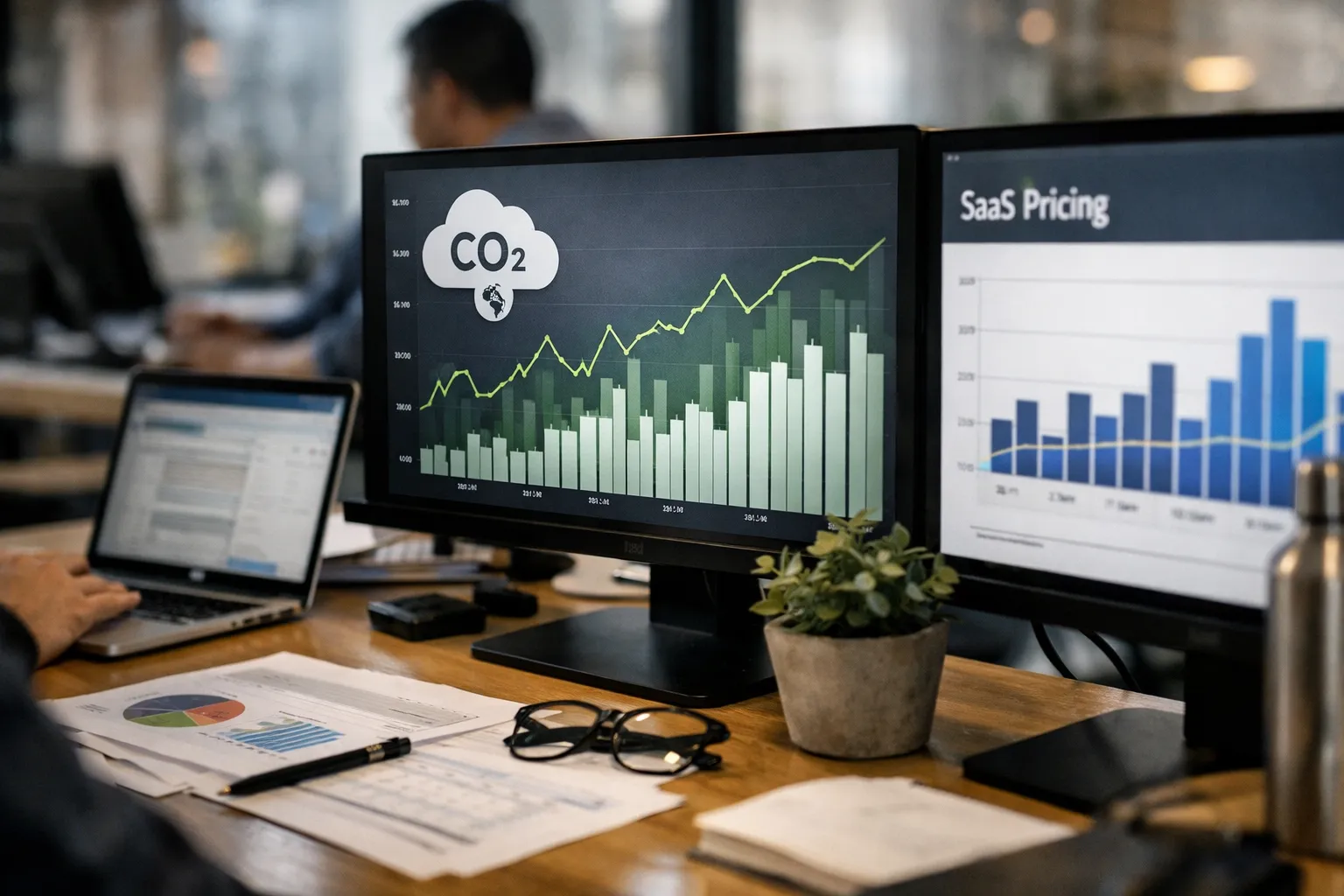
Who: SaaS vendors from startups to public companies. What: carbon‑aware pricing — per‑usage carbon metrics, green tariffs and invoice line‑items for offsets. When: September 2026. Where: driven by EU regulation and global cloud providers but affecting vendors selling to international buyers. Why: EU Corporate Sustainability Reporting Directive (CSRD) deadlines, stronger procurement demands and improved emissions APIs from major cloud platforms.
Context: regulation, procurement and better cloud data
The push that began in 2024 around sustainability reporting has accelerated into practical pricing changes in 2026. The CSRD’s second wave — companies brought into the scope at the start of 2026 — must report under European Sustainability Reporting Standards (ESRS) for financial year 2026, with disclosures due in 2027. That timetable has procurement teams at large corporates asking suppliers, including SaaS vendors, for granular emissions data tied to software consumption.
At the same time, cloud providers and third‑party tooling have matured. AWS, Microsoft Azure and Google Cloud continue to publish customer carbon‑footprint tools and improved emissions attribution APIs; open‑source projects and commercial vendors now offer libraries that combine cloud telemetry with region‑level grid intensity factors. Those capabilities have reduced the engineering barrier to estimating per‑usage CO2e for compute, storage and network operations.
New market data: who’s doing what in September 2026
Usage Billing Report surveyed 132 SaaS vendors in August 2026 (sample: 60% $50M ARR, 30% $50M–$500M ARR, 10% >$500M ARR). Key findings:
- 41% expose some form of per‑usage carbon metric in billing or customer dashboards (up from ~15% in mid‑2025).
- 28% offer a paid "green" tariff or routing option that promises lower‑carbon infrastructure or bundled renewable purchases.
- 35% present optional offsets or removals as invoice add‑ons, with typical prices of $8–$30 per tonne CO2e depending on project type selected.
- Only 22% publish verification artifacts (RECs, Guarantees of Origin, third‑party offset certificates) in machine‑readable form alongside invoices.
"The pace of adoption surprised us," said Ana López, senior analyst at Usage Billing Report. "What changed in 2026 was not just intent but deliverability — cloud vendors published more granular APIs and buyers started requiring verifiable metadata as part of procurement."
Concrete examples and vendor approaches
Three practical patterns have emerged across vendors we reviewed in August 2026:
- Visibility only: Vendors add an estimated CO2e column next to traditional usage metrics (for example, "100,000 API calls — est. 12 kg CO2e") to help procurement reconcile supplier data into their CSRD filings.
- Green tariffs: Premium service tiers route eligible workloads to lower‑carbon regions, purchase additional renewable energy certificates (REGOs/RECs) or procure bundled virtual power purchase agreements (vPPAs) on behalf of customers. Those tariffs typically range from a 3% to 15% premium, depending on vendor cost and guarantee level.
- Offsets/removals on invoices: Vendors surface optional offsets as discrete invoice line items, integrating with third‑party marketplaces. Popular choices in 2026 are nature‑based removals and technological carbon removals, with buyer concern growing about permanence and verification.
Pricing, billing and compliance implications
Embedding climate into prices introduces complexity across metering, product, revenue and legal teams:
- Metering accuracy and uncertainty: Per‑usage CO2e estimates remain probabilistic. Vendors we surveyed report typical estimation uncertainty of ±20–40% for API‑level metrics depending on workload transparency and cloud provider data fidelity.
- Invoicing metadata: Procurement increasingly expects machine‑readable evidence: timestamped usage, region of execution, emissions factor applied and proof of any REC/offset purchase. Only a minority of vendors currently automate that output.
- Revenue operations change: Conditional pricing (e.g., an API rate that varies by carbon intensity window) requires billing platforms that support dynamic price rules and audit trails. Many legacy systems will need middleware or replacements.
- Verification and auditability: Buyers demand links to RECs, REGOs or third‑party offset certificates. Without that, vendor green claims may be treated as marketing rather than reportable procurement data for CSRD.
Impact: who is affected and how
Procurement and compliance teams at large corporates gain line‑level data to assemble Scope 3 supplier emissions for CSRD/ESRS. For SaaS vendors, the impacts split by company size:
- Small vendors ($50M ARR): Face engineering cost to estimate and present CO2e but can experiment with offsets to meet buyer asks.
- Mid‑market vendors ($50M–$500M ARR): Adopt green tariffs selectively for strategic accounts and build verification partnerships.
- Large vendors (>$500M ARR): Invest in integrated solutions — region routing, renewable procurement, and machine‑readable invoice metadata — to meet enterprise procurement SLAs.
Reactions from buyers and market actors
Procurement leaders at three European financial institutions interviewed in August 2026 told Usage Billing Report they now treat supplier carbon data as a gating factor in RFPs for software that contributes material Scope 3 emissions. "We cannot complete our ESRS reporting without line‑level supplier data," said a procurement director at a Dutch bank (requested anonymity). "SaaS vendors that can deliver verifiable metadata will win more controlled spend."
Industry groups and a handful of market working groups convened in 2026 to draft common metering taxonomies; however, no pan‑industry standard has been ratified yet. That fragmentation is why many buyers insist on raw data fields rather than vendor‑specific summary metrics.
What pricing and finance teams should do now (updated checklist)
- Audit metering sources (Q3–Q4 2026): Map product usage to cloud telemetry and identify where uncertainty exceeds ±30%. Prioritize high‑impact metrics (API calls, batch compute hours, data egress).
- Define invoice metadata (by Dec 2026): Add machine‑readable fields: timestamp, region, usage unit, emissions factor ID, and proof links for any REC/offset purchase. Pilot with 5–10 strategic customers.
- Choose verification partners (now): Pre‑qualify REC, REGOs and offset suppliers and require digitally signed certificates. Maintain an audit repository for buyer requests.
- Test pricing pilots (Q1–Q2 2027): Run segmented experiments: visibility only, small per‑unit carbon surcharge, and premium green tariffs. Track churn and procurement conversion rates per cohort.
- Upgrade billing stack where needed (2027 roadmap): Evaluate platforms or middleware that support dynamic line items and attachable audit metadata to invoices.
What to watch next
- FY2026 CSRD filings due in 2027 — expect a fresh round of procurement RFPs that reference supplier emissions data.
- Standardization efforts: pilots of common metering taxonomies are likely through 2027; vendors that participate will be advantaged in enterprise deals.
- Regulatory scrutiny: buyers and auditors will increasingly expect machine‑verifiable proof rather than vendor assertions; poorly documented green claims risk procurement rejection and reputational damage.
How to prioritize investment?
Start with visibility: add estimated CO2e next to key usage metrics and produce downloadable CSV exports with the minimal verification fields buyers request. Then pilot paid options with a small set of strategic customers while building the verification and billing automation required for scale.
FAQ
Do offsets reduce reported emissions for CSRD/ESRS?
No. Under common accounting frameworks, offsets or offsets purchases do not reduce the amount of emissions an entity reports for Scope 1/2/3; they are disclosed separately as mitigation actions or compensation. Buyers will still need the underlying activity‑based emissions data to complete ESRS disclosures; offsets can be reported as complementary evidence of compensation.
How accurate are per‑API‑call CO2e estimates today?
Estimates vary. In practice many vendors report uncertainty in the ±20–40% range depending on whether execution location and cloud instance type are known. Accuracy improves when you can tie a usage event to a specific region and instance family and use provider‑supplied energy attribution APIs.
Should we charge customers for carbon or just show it?
It depends on customer mix. For enterprise buyers with reporting mandates, visibility is table stakes. Charging is most viable as a premium option (green tariff) for buyers willing to pay for guarantees or a per‑unit surcharge that funds verified renewables/removals. Pilot both and measure procurement conversion and net retention.
What minimum invoice metadata do buyers ask for?
Procurement teams typically request: usage timestamp, resource/region of execution, usage quantity, emissions factor identifier (with source), and proof links for any REC/offset purchase (certificate IDs). Delivering CSV/JSON exports with these fields is the quickest path to meet enterprise needs.
For SaaS pricing teams, carbon‑aware pricing moved in 2026 from a niche experiment to a practical commercial lever. The immediate winners will be vendors that pair transparent metering with auditable verification and a staged pricing rollout tied to buyer needs — not marketing claims. With CSRD reporting real for many customers, the decision now is not whether to act but how quickly and credibly to do so.