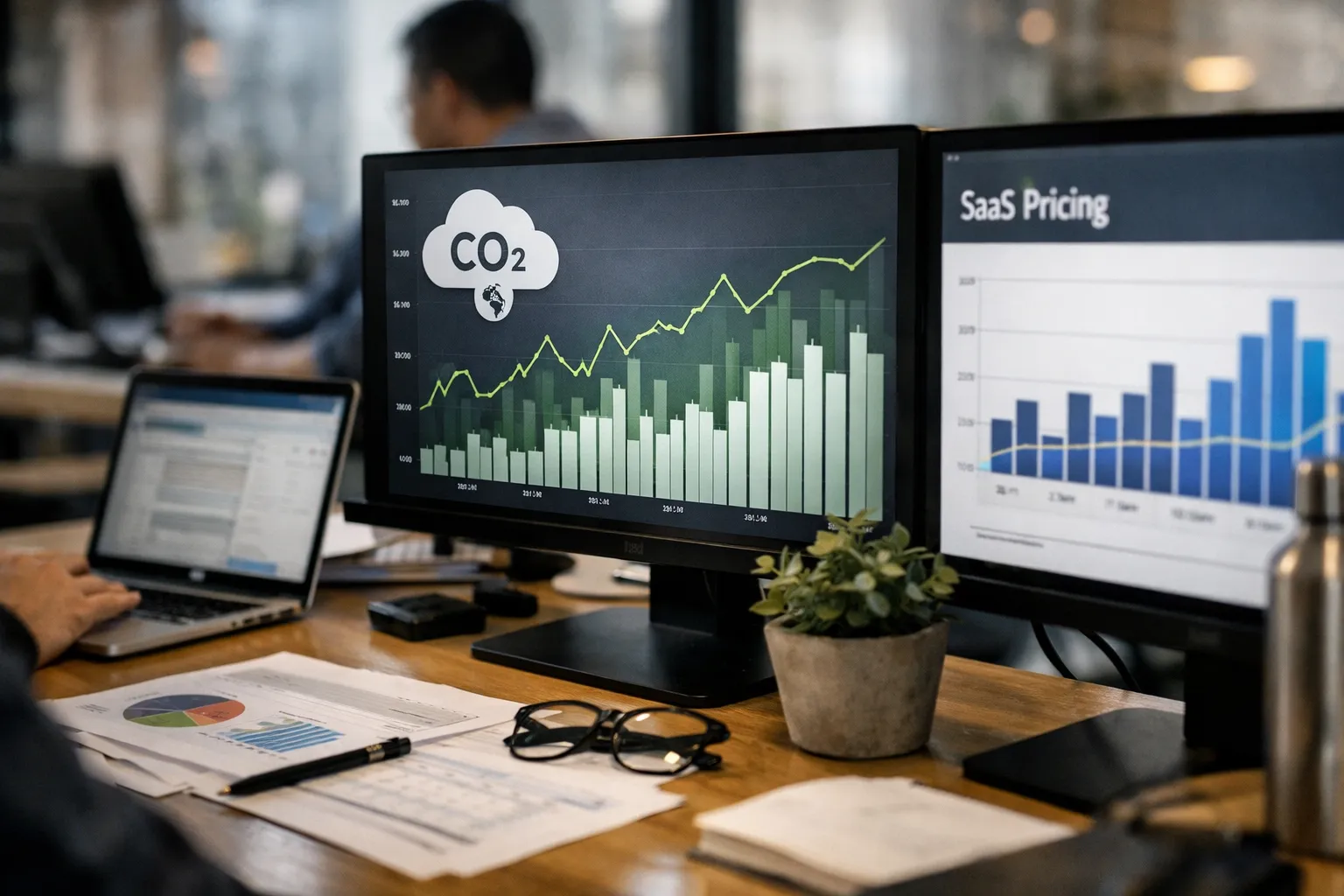
The European Union's expanding sustainability reporting regime and growing corporate procurement demand for emissions transparency are driving a new wave of "carbon‑aware" pricing in the SaaS market. Vendors from startups to large cloud providers are beginning to publish per‑usage carbon metrics, test green pricing tiers and bundle offset options into invoices — a shift that promises new revenue streams and headaches for pricing, billing and compliance teams.
Why now: regulation meets buyer pressure
Two forces converged in early 2026. First, the EU Corporate Sustainability Reporting Directive (CSRD) — now in later phases of rollout — requires many organizations to disclose greenhouse gas emissions and related metrics under the European Sustainability Reporting Standards (ESRS). Procurement teams at large corporates facing CSRD obligations are asking suppliers, including SaaS vendors, for granular data on the emissions linked to software consumption.
Second, major cloud platforms have accelerated carbon visibility tools. AWS, Microsoft and Google Cloud already publish customer carbon footprint tools and sustainability dashboards; Salesforce offers Net Zero Cloud to help customers track emissions tied to CRM usage. Those vendor tools make it practical for SaaS companies of all sizes to estimate the carbon intensity of compute, storage and network consumption tied to their products.
Immediate vendor responses
- Visibility: Several SaaS vendors have started exposing per‑unit carbon metrics alongside usage metrics in billing dashboards. Instead of "100,000 API calls," invoices may show "100,000 API calls — estimated 12 kg CO2e."
- Green tariffs: Some vendors pilot premium "green" plans that route workloads to lower‑carbon regions or invest in verified renewable energy purchases on behalf of customers, for an added fee.
- Offsets as line items: A growing number of billing systems now offer optional, third‑party verified offsets as invoice line items or subscription add‑ons, priced per ton of CO2e.
Pricing and billing implications
Embedding sustainability into pricing introduces multiple complexities for SaaS finance and pricing teams.
- Metering granularity: Carbon intensity varies dramatically by workload, region and time of day. Accurate per‑usage carbon metering requires integrating cloud provider tools with product usage data and converting energy consumption into CO2e using appropriate emissions factors.
- Variable costs and premiums: Offering a "low‑carbon" route can justify a price premium, but vendors must balance the premium against customer willingness to pay and the real cost of procuring renewable energy or low‑carbon infrastructure.
- Invoicing complexity: Billing teams may need to add new line items for carbon charges, offsets or green tariffs and provide verifiable breakdowns to satisfy CSRD disclosure requests.
- Verification and audit trails: Procurement and compliance teams require verifiable proof — proof of energy attribute purchases, renewable energy certificates, or third‑party verification — to rely on vendor claims for their own reporting.
Operational challenges for finance teams
Price architects and revenue operations teams will need tighter integration between metering, product analytics and accounting systems. Charging customers for carbon‑intensive consumption implies dynamic pricing elements — for example, an API rate that varies not only by volume but by the carbon intensity of the region where the call executes. Existing billing platforms and legacy invoicing systems are not uniformly equipped to handle those conditional line items and audit metadata.
Standards and the risk of greenwashing
Adding sustainability to pricing raises the risk of inconsistent claims and greenwashing. Industry observers say buyers will demand adherence to established accounting frameworks such as the GHG Protocol for emissions accounting and independent verification of any offsets or renewable energy purchases.
Market participants are beginning to call for standardized metering taxonomies — a common unit for reporting carbon per compute‑minute, per GB transferred or per API call — and standardized labels for "carbon‑adjusted" price lines. Without consistent standards, procurement teams will face a patchwork of vendor statements that are hard to compare.
Where innovation is likely next
Several practical innovations are emerging as responses:
- Carbon price add‑ons: A per‑unit carbon surcharge (e.g., per 1,000 API calls) that funds renewable purchases or offsets, shown transparently on invoices.
- Time‑shifted discounts: Lower prices for non‑urgent compute scheduled during low‑carbon hours in a region, encouraging customers to shift workloads.
- Bundled sustainability SLAs: Service tiers that guarantee a share of low‑carbon compute or priority routing to zero‑carbon infrastructure.
What SaaS pricing teams should do now
- Audit current metering: Map usage metrics to cloud carbon calculators and identify where estimates are weakest.
- Engage procurement and compliance: Understand what buyers need for CSRD or voluntary reporting and design invoice metadata accordingly.
- Choose partners for verification: Select reputable offset and REGO/REC providers and be ready to publish proof.
- Test customer willingness to pay: Pilot green tariffs or carbon line items with strategic accounts before wide rollout.
For SaaS vendors, the push for carbon‑aware pricing is both a compliance response and a commercial opportunity. Companies that transparently meter and price the climate cost of software consumption can better support large buyers’ reporting needs and potentially capture a premium for lower‑carbon delivery. But success will depend on accurate metering, standardized reporting and a willingness to invest in billing and verification infrastructure — work that must be done in the months ahead as CSRD and corporate buyer expectations continue to tighten.